
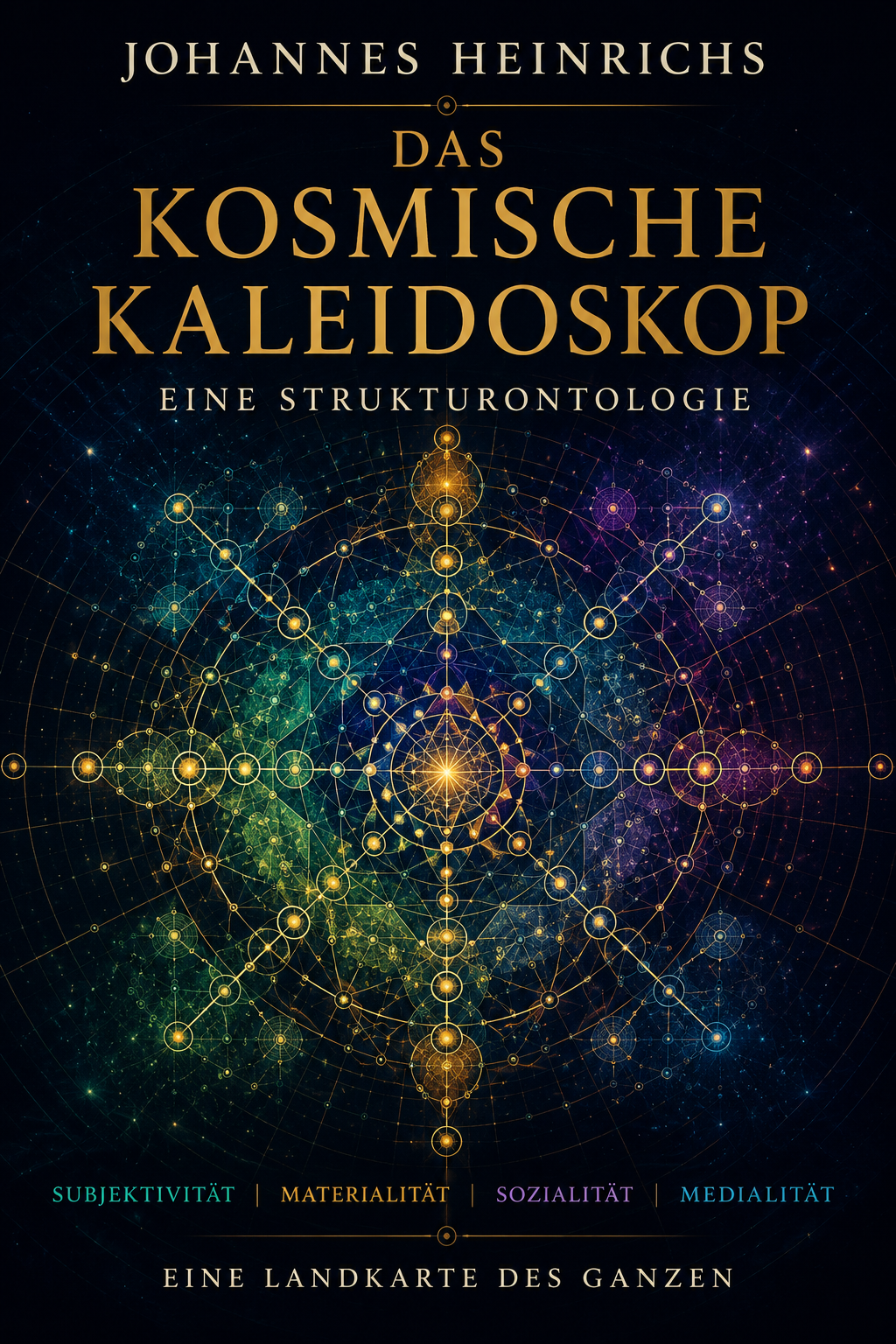
Das kosmische Kaleidoskop
Eine Strukturontologie von Subjektivität Natur Sozialität und Medialität
📕 E-BookA Map of the Whole
The Cosmic Kaleidoscope is Johannes Heinrichs’ grand design of a structural ontology — the attempt to understand every domain of reality from a single, continuous ordering principle. Not as one more special theory alongside the individual sciences, but as a systematic determination of place: it shows where the phenomena — from matter to the sacred — have their place within the whole of meaning.
The work brings the logic of reflection that Heinrichs has developed over five decades to its most comprehensive application. What Dialectics as Logic of Reflection grounded as method is here played out across the whole cosmos.
The Basic Idea
Heinrichs takes up an ancient philosophical task: the topics, conceived by Aristotle as the doctrine of the “places” of thought, developed further by Kant as a “transcendental topic.” In a world of fragmented specialized knowledge, we increasingly lack the capacity to clarify where a question actually belongs and under what presuppositions it can meaningfully be posed at all. This is precisely where the book begins: it offers a grounded overview that makes visible in which fundamental fields of meaning knowledge, practical orientation, and cultural self-interpretation each have their place.
The Four Domains of Meaning
The book is divided, according to the four “elements of meaning” — I, It, You, and Medium — into four large parts, in each of which the same reflexive fourfoldness recurs analogously:
Subjectivity — the human subject as self-reference within reference-to-the-other, as the epistemological and ontological centre of all further contexts of meaning.
Materiality — inorganic, vegetative, animal, and human-bodily nature, structured according to the fourfoldness of mass, energy, interaction, and measure and number.
Sociality — the fabric of social reality from the I-You relationship to humanity as a whole, in economy, politics, culture, and fundamental values, toward a systems-theoretically grounded theory of democracy.
Mediality — the medium of meaning that already underlies all the other domains: as waves and the logos-analogous deep structure of matter, as senses and resonance in the subject, as language and the collective unconscious — and finally as the self-reflection of the universal medium, reaching into a foundation for philosophical theology.
What Is Special About This Book
Where most philosophical works deepen a single domain, The Cosmic Kaleidoscope dares the reach toward the whole — methodically rigorous, not arbitrarily speculative. The fourfold structure is no rigid scheme but a “reflection-graded algorithm” that permits fractal subdivisions and makes the particular intelligible as a special instance of a more encompassing context of meaning, without depriving it of its distinctiveness.
The result is an orienting cartography of being — an invitation to see reality anew as a thoroughly structured, meaningful whole.
For Whom?
For all who seek the connection behind the individual disciplines: for the philosophically interested as much as for readers with a feeling for the great, holistic questions of nature, mind, and cosmic order. The book presupposes no specialized knowledge, but rewards the willingness to follow a demanding train of thought to its “quod erat demonstrandum.”
Bibliography
- Year
- 2026
- Series
- Gesammelte Werke (Volume 48)
- License
- Copyright
Where to Buy
Price: 29.90 EUR/USD
| Language | Books | Format | Buy |
|---|---|---|---|
| 🇩🇪 Deutsch | Das kosmische Kaleidoskop | EPUB, PDF |